
Commercial Readiness: What Deep-Tech Investors Want Now
Commercial readiness has become the defining factor in deep-tech fundraising and scale. In 2026, investors are underwriting more than breakthrough technology they’re looking for execution clarity: buyer alignment, pilot-to-deployment pathways, strategic partnerships, and repeatable commercial signals that survive diligence. This post breaks down what venture capital firms actually mean when they ask for “commercial proof,” and how founders can build investor-ready momentum before revenue or a full commercial team.
1/31/20264 min read
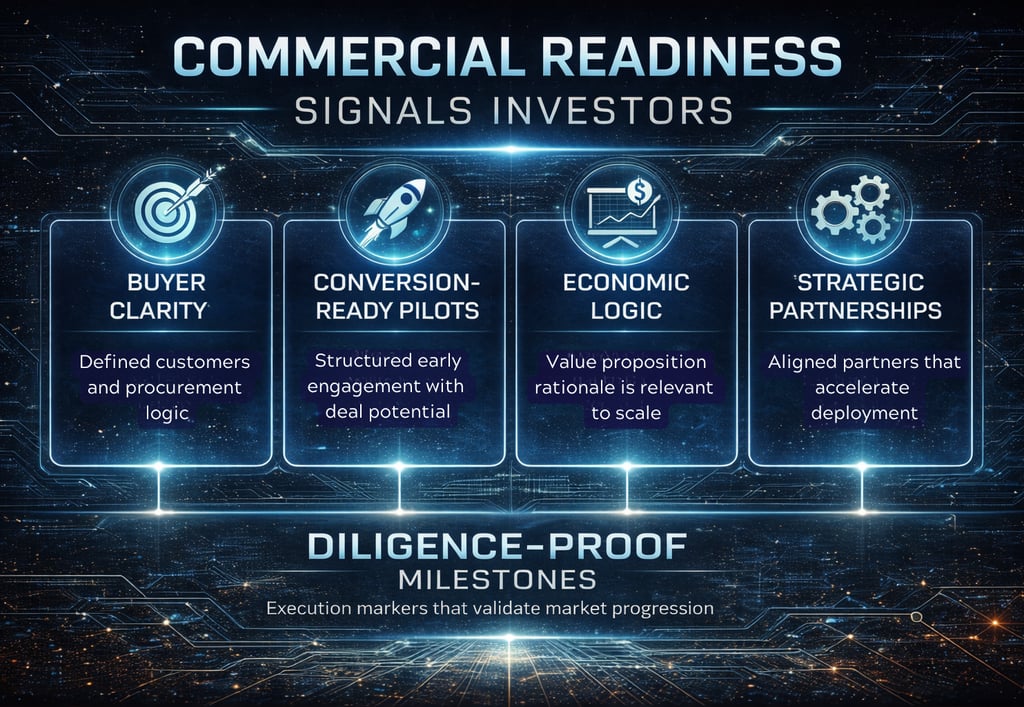
After a year where Commercial Edge™ clearly separated deep-tech leaders from the rest, one question is rising to the top for founders entering 2026: What do investors actually mean when they say they want “commercial readiness”?
In 2025, capital flowed toward startups that didn’t just demonstrate technical breakthroughs, but could articulate credible pathways to deployment, adoption, and value capture. Deep tech remains fundamentally science-driven but the market is increasingly underwriting execution clarity over novelty.
In their 2023 Investor’s Guide to Deep Tech, Boston Consulting Group noted that deep tech now accounts for roughly 20 percent of global venture capital, reflecting growing investor conviction in frontier innovation but also increasing selectivity around which companies can truly scale beyond the lab.
In this environment, commercial readiness has become one of the most important gating factors in fundraising, partnerships, and long-term viability.
Commercial Readiness Is Not Revenue
Founders often interpret investor feedback like:
“The technology is impressive, but we need more traction.”
“We need commercial proof.”
“The go-to-market path isn’t clear yet.”
It’s easy to hear this as: sell more. But in early-stage deep tech, commercial readiness is rarely a revenue requirement. It is a risk and execution requirement. Investors are asking a different question: Has this team demonstrated a repeatable, risk-managed path to adoption and value capture?
Commercial readiness is about clarity, not scale.
What Investors Are Actually Underwriting
Particularly in deep tech, where timelines are long and technical uncertainty is real, investment committees evaluate readiness through commercial signals such as:
A clearly defined buyer and buying process
Early engagements structured with conversion pathways
Pricing and economic logic that can scale beyond pilots
Partner commitments that reduce deployment friction
Evidence of repeatability across more than one customer or market node
Investors are not simply funding technology. They are underwriting a company’s ability to translate technology into durable market outcomes.
A 2025 Case Study: Capital Followed Commercial Clarity
One of the clearest examples of this dynamic in 2025 came from autonomy. Wayve, a UK-based autonomous driving startup, raised a major late-stage round in a market that remains disciplined about autonomy risk. What made the round notable was not simply its size, but how it was positioned.
By the time Wayve raised capital, investors were no longer underwriting autonomy as a science experiment. They were underwriting:
Integration into existing mobility ecosystems
Time-to-deployment through strategic partnerships
Capital efficiency through a software-first model
Strategic optionality for platform expansion
In capital-markets terms, Wayve reduced execution risk. The company’s commercial narrative such as their deployment pathways, partner alignment, and scalable adoption logic all supported a strong close because it held up under diligence.
The takeaway for founders is straightforward: the best rounds are not won on technology alone. They clear because commercial pathways are credible.
Commercial Readiness vs. Pilot Activity
Many founders celebrate early pilots as proof of traction. But investors interpret pilots differently. A pilot is an input. Commercial readiness is demonstrated when a pilot becomes part of a structured progression:
Pilot → Deployment logic
Technical validation → Procurement alignment
Interest → Commitment
Experimentation → Repeatability
This distinction is why so many deep-tech companies stall between demonstration and scale which is a theme we explored previously in our insight: “From Pilot to Proof: How Startups Can Build Investor and Market Confidence”.
Investors are looking for commercial signal architecture, not activity volume.
Why Partnerships Matter More Than Ever
In infrastructure-heavy sectors like fusion, climate, and industrial systems, partnerships are often the mechanism that makes commercialization investable.
Consider Commonwealth Fusion Systems (CFS). Fusion remains a long-duration technological frontier but CFS has continued to attract capital and strategic support because commercial alignment is treated as mission-critical alongside technical progress.
Industrial partnerships, government alignment, and long-horizon capital structures reduce financing risk by matching incentives and timelines. These are not partnerships for optics. They are commercial infrastructure. This is exactly the strategic lens we’ve discussed in Turning Suppliers into Partners and Investors and Accelerate Time to Market by Leveraging Partner Strengths.
Why Founders Often Misread the Investor Signal
Founders naturally emphasize:
Performance benchmarks
Technical differentiation
Mission and long-term impact
Investors, however, are focused on:
Adoption pathways
Procurement dynamics
Contract and pricing survivability
Repeatability and scalability
Risk-adjusted timelines
This is why technically extraordinary companies can still struggle to raise: the execution narrative does not map cleanly to how capital allocators evaluate risk and return.
Commercial readiness is fundamentally about alignment between founder intent and market reality.
How to Build Commercial Readiness Early
Founders can begin strengthening readiness long before revenue by focusing on four practical disciplines:
Define the buyer’s decision process
Budget authority and risk thresholds matter more than enthusiasm.Structure pilots with conversion embedded
A pilot without a path forward is a demo, not a commercial instrument.Tie outcomes to economic value
Investors want to understand what success costs, saves, or enables.Build milestones that survive diligence
Repeatable commercial logic beats complex storytelling.
Commercial readiness is built deliberately not discovered at the Series A boundary.
What This Means for Founders in 2026
The signal coming out of 2025 is clear:
Deep tech continues to attract capital
But markets are underwriting execution more selectively
Investors fund clarity before they fund scale
Commercial readiness is no longer optional. It is the lens through which investors and enterprise buyers evaluate whether your next phase is fundable, deployable, and defensible.
Closing Thoughts: Founders who build commercial architecture early don’t just raise capital they raise it with stronger positioning, clearer use-of-proceeds logic, and greater long-term viability. Investors don’t just fund innovation. They fund credible execution pathways.
If you’re preparing for your next phase of growth and want to pressure-test your commercial readiness; from pilots to partnerships to investor expectations; we welcome the conversation.
©Agrotera Group™. All rights reserved.

