
If Your Startup Technology Works but Isn’t Scaling, Here’s Why
Your technology works. The pilot succeeded. But nothing is scaling. Deep-tech startups don’t fail because the technology doesn’t work. They fail because it never finds a clear path into real-world systems. This post explains why deep-tech startups stall after validation and how to define the target market pathway that turns breakthroughs into real deployment and scalable adoption investors will underwrite.
5/30/20267 min read
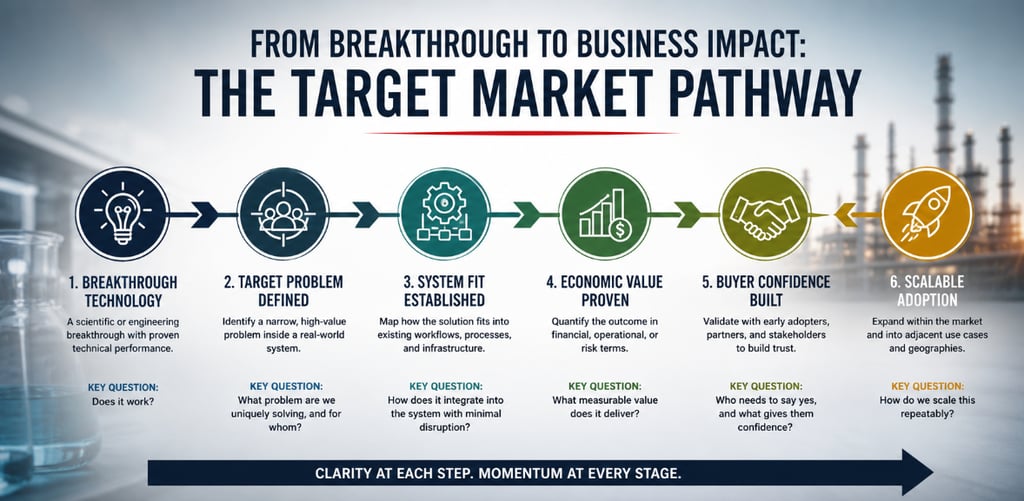
If You Can’t Define the Commercial Pathway, You Don’t Have a Business Yet
Deep tech rarely breaks in the lab. It breaks later when something that clearly works has nowhere obvious to go. Most deep-tech founders build something that works. That part is rarely the issue. The problem shows up later when the question shifts from “does it work?” to “where does this actually get used?”. This is the transition is where things slow down.
According to McKinsey & Company, deep tech could generate up to $1 trillion in enterprise value and millions of jobs by 2030. At the same time:
deep tech now represents ~20% of global venture capital funding, up from ~10% a decade ago
yet most companies still fail to transition from prototype → scaled deployment
This is not a demand problem. It is a translation and commercialization problem.
Deep tech doesn’t fail because no one wants it. When failure occurs it’s often because no one knows how to adopt it.
The Problem Isn’t the Technology
Most teams get the hard part right. The model performs. The system holds up under testing. It delivers results in controlled environments. The results are real.
Then the conversation shifts. Not “does it work?” But something more uncomfortable: “where does this actually get used?”, “who is responsible for that part of the operation?”, “what budget covers it?”. That’s where things slow down.
They struggle to turn early success into something that holds up at scale.
This is increasingly reflected in industry data.
In its 2023 Technology Vision report, Accenture highlights that while organizations are rapidly adopting emerging technologies, the primary constraint is not access or experimentation it is the ability to translate early success into sustained business value at scale. That translation gap is where most deep-tech startups stall.
Where It Starts to Drift; the Lab-to-Market Gap
Ask most founders what they’ve built and they’re sharp. Ask where it fits inside a working system and the answers get looser.
There’s usually a range: “It could apply to…”, “We’re exploring…”, “Several industries are interested…”.
That’s not a market. That’s optionality.
In its 2022 Tech Trends report, Deloitte pointed to the same pattern inside large organizations that there are lots of pilots, far fewer deployments. Not because the tools fail. Because no one worked out how they actually get used.
Broad Markets Don’t Adopt Anything
“AI for healthcare” sounds ambitious. It doesn’t help anyone make a decision.
Adoption happens in narrow places where there’s already:
a defined problem
a team responsible for it
a cost if it goes wrong
Everything else stays in evaluation mode.
In its 2023 research on scaling innovation, Capgemini emphasizes that leading organizations are moving beyond experimentation by building operational and commercial foundations that allow technology to scale across the enterprise not just perform in isolated use cases.
The companies that move past pilots connect new technology to how the business already runs. The rest keep experimenting.
What It Looks Like When It’s Done Properly (5 Real World Examples)
You see the same pattern in startups that actually scale. They don’t start wide. They start somewhere specific and make it work there. That decision to start with a problem that already had operational urgency shows up again in very different deep tech industries.
Permasense is an example of a company that could have gone in a dozen directions with its sensing technology. It didn’t. Instead Permasense focused on corrosion inside oil and gas refineries. They did this because that problem already had:
owners
budgets
real consequences
The product wasn’t framed as a sensing breakthrough. It was framed as a way to avoid shutdowns. This decision gave them a clear entry point into an existing system and a path to scale that didn’t require re-educating the market. That’s what made it usable.
Through early engagement with operators like BP, the company reframed its technology not as advanced sensors but as a way to prevent multi-million-dollar shutdowns. That clarity of value, tied to a specific operational pain point, ultimately led to its acquisition by Emerson.
The same discipline shows up when the constraint isn’t operational risk, but regulatory pressure. Puraffinity is another company that made a similar call. The company developed advanced materials capable of removing PFAS (“forever chemicals”) a highly technical breakthrough. The underlying science is dense. That’s not what led the conversation. They went after environments where PFAS compliance was becoming unavoidable. Puraffinity focused on airports and industrial water systems. They weren’t selling a material. They were solving a compliance problem without forcing a full redesign. That’s a very different conversation. By anchoring the product in compliance rather than chemistry, Puraffinity moved from technical validation to commercial relevance much faster. They targeted:
regulated environments
compliance-driven buyers
industries under immediate pressure to meet standards
They positioned their solution as a guaranteed path to regulatory compliance, not a materials innovation. That translation unlocked commercial traction.
In more complex procurement environments like the defense sector, the same principle applies because clarity of use case reduces friction. Anduril Industries didn’t show up as an AI platform for the defense industry. It showed up with a system for border surveillance and base security which was something operators could use without needing to understand how it worked underneath. Having a clear use case and defensible solution that resonates with buyers matters more than most founders expect. That clarity allowed them to move faster than traditional contractors, because the value was already aligned with how decisions get made.
In manufacturing the entry point often isn’t a system; it’s a product. Carbon didn’t try to change manufacturing overnight. They worked on one product with Adidas. A midsole. Carbon focused on: defined requirements, real constraints and actual production. From there, the rest becomes possible. That single use case did more than prove the technology. It made it credible inside real production environments.
And in sectors where margins are tight, the translation has to be even more direct. Blue River Technology didn’t sell computer vision. They sold a way to cut herbicide use significantly which is a concrete number decision makers can act on. That clarity turned a complex system into a straightforward economic decision and made adoption easier to justify at scale.
The Pattern Is Not Subtle (What’s Consistent Across Our 5 Examples?)
None of these companies tried to explain their technology first. They started with a specific point of failure, a system that already exists and a result that matters financially. Everything else followed from that.
Same structure every time:
Start with a problem that already exists.
Place the technology inside it.
Tie it to something measurable.
No one is buying the technology in isolation. They’re solving something they already recognize.
Where Things Usually Go Sideways
This is where most teams drift off course. They land a pilot. Usually through an innovation group. It works. Feedback is good.
Then it moves into the rest of the organization. Procurement asks where it sits. The Operations group asks who owns it. And Finance asks what it replaces.
Without it momentum disappears quickly. If those answers weren’t worked out early, the deal slows down. Then it stops. Nothing dramatic. It just… stops moving.
The translation must be explicit:
“10nm resolution” → irrelevant
“reduces defect costs by $200k per line” → actionable
“faster compute” → vague
“reduces simulation time by 80%” → compelling
This is not positioning. It is the difference between pilot and scale.
The Work That Actually Matters (Translation into Existing Systems)
At some point, every deep-tech company has to do the same thing: take something complex and make it legible inside someone else’s system by tying performance to cost, time, or risk; fitting into an existing workflow; and giving someone a reason to say yes without rewriting how they operate. It’s not a messaging exercise. It’s structural.
It is about defining a narrow use case, within a specific industry system, tied to a clear economic driver.
The work isn’t explaining the technology better. It’s making it fit:
Fit into a workflow.
Fit into a budget.
Fit into how decisions already get made.
That usually means translating performance into: cost avoided, time saved and risk reduced. And doing it in a way that someone inside the organization can defend.
A Practitioner's Observation: Markets Are Designed, Not Found
The strongest deep-tech companies don’t search for markets. They engineer entry points into them. This requires:
Niche Market Targeting. Start where your technology is: non-substitutable, mission-critical, economically meaningful.
Industrial Partnership Pathways. Engage early with: OEMs, system integrators, strategic partners but not as customers engage with them as market access mechanisms.
Economic Translation. Tie technical progress directly to: cost reduction, throughput improvement, risk mitigation. If value cannot be quantified, adoption will not scale.
Trust Before Scale. Deep-tech adoption is high-risk. Which means trust is not optional; it is foundational to your success.
This is reinforced by Accenture’s research, which shows that trust is a limiting factor in scaling advanced technologies across enterprises. Without trust: adoption slows, procurement stalls, scaling breaks.
Deep tech startups are not traditional companies. They are translation engines converting scientific breakthroughs into deployable systems inside real-world industries. And demonstrating this builds trust.
But most founders still approach commercialization sequentially: Build the technology → then find the market. That model breaks in deep tech. Because the core challenge isn’t invention. That invention needs to be translated into trusted, economically meaningful outcomes that decision makers can understand in their current environments.
Founders in R&D intensive industries naturally lead with: performance, accuracy, resolution, and speed. But markets don’t adopt specifications. They adopt economic outcomes. And investors fund startups with proven, scalable revenue underpinning these economic outcomes in those markets.
Closing Thoughts:
A working prototype is not the milestone most founders think it is. It doesn’t get you very far on its own. Neither does a pilot. Things start to move and the real shift happens when the technology has a place to land cleanly into a system that already runs with people who already know how to evaluate it. Until then, it’s not a demand problem. It’s a placement problem. The key to successfully closing deals with decision makers is in your translation.
Market discovery must run in parallel with R&D. Because the real challenge is not invention. It’s translation; turning technical capability into: trust, measurable value and deployable outcomes. The cost of getting this wrong is significant.
You don’t have a business when your technology works. You don’t have a business when someone is willing to pilot it. You have a business when: your technology is embedded in a defined, scalable specific market pathway where your technology is indispensable.
If you’re working through where your technology actually fits and how it gets adopted, let’s have a conversation.
Empowering deep tech startup founders with strategic commercialization advice.
Partners
Growth
partner@agroteragroup.com
+15127301855
© 2025. All rights reserved.
Agrotera Group