
Pilots Are Not Proof and Markets Know the Difference
Deep-tech startups often stall between pilot success and real market adoption. Learn how to design pilots that signal commercial readiness to customers and investors. We highlight how to structure pilots as early commercial instruments demonstrating buyer demand, deployment pathways, and the signals investors look for before funding growth. Convert pilots into commercial traction and investor confidence.
2/27/20264 min read
Most deep-tech startups don’t fail at the lab bench. They fail in the gap between pilot and scale.
Across robotics, autonomous systems, energy, and advanced materials, founders often celebrate pilot success as the moment their technology “breaks through.” Yet the market reads pilots very differently than founders do.
McKinsey’s 2025 State of AI survey found that while 88 percent of organizations use AI in at least one business function, only about one-third have begun scaling it across the enterprise and just 39 percent report any measurable EBIT impact at all. The principle holds across deep tech broadly: most organizations experiment, few convert. The issue isn’t performance; it’s conversion.
A pilot proves capability. Commercial proof demonstrates commitment.
What Happens When Pilots Are Designed for Learning, Not Scale
Consider Drive.ai an early leader in autonomous driving. The company ran high-profile pilots, including public self-driving services in Texas and partnerships with major ride-hailing platforms. Technically, the pilots worked. Strategically, they lacked durable commercial conversion paths.
Without firm procurement mechanisms, pricing frameworks, or long-term deployment structures, those pilots remained demonstrations, not scalable revenue engines. In June 2019, Drive.ai was acquired by Apple widely reported as an acqui-hire, with Apple primarily interested in the engineering talent rather than the commercial platform. The company had raised $77 million at a $200 million peak valuation; the acquisition price was reportedly below its total funding raised. Its technology was absorbed into Apple’s Project Titan, not scaled independently. A technically credible pilot program ended as someone else’s R&D asset.
Contrast that with Nuro. Nuro also began with pilots, but critically, those pilots were embedded in real commercial workflows. Its autonomous delivery programs with Kroger, Walmart, and CVS were tied to operational use cases, customer demand, and repeat deployment potential not just feasibility testing. Investors treated those engagements as early commercial signals. SoftBank invested $940 million at a $2.7 billion valuation in 2019; by November 2020, a Series C led by T. Rowe Price pushed the valuation to $5 billion before Nuro had achieved traditional revenue scale. The difference was not technical superiority. It was commercial architecture.
What Investors Actually Fund: Pilots With a Commercial Path
A third example, Wayve, highlights how pilots become proof when they are designed as stepping stones rather than endpoints. Wayve’s collaborations with global mobility platforms moved beyond feasibility testing into operational readiness within existing commercial ecosystems.
Investors responded accordingly. In May 2024, Wayve closed a $1.05 billion Series C led by SoftBank, with NVIDIA and Microsoft also participating reported as the largest-ever investment in a UK AI company at the time. The round was tied not just to model performance, but to evidence that Wayve’s technology could integrate into real automotive and logistics ecosystems with real commercial buyers. By February 2026, Wayve had raised a further $1.5 billion at an $8.6 billion valuation, with Uber joining as a strategic investor tied to a planned autonomous robotaxi deployment across more than 10 markets.
What Commercial Proof Actually Looks Like
The pattern extends well beyond autonomous vehicles. Redwood Materials, the advanced battery recycling company founded by former Tesla CTO JB Straubel, faced a similar challenge in a completely different sector. Its core innovation; recovering lithium, nickel, and cobalt from used batteries; was technically impressive. But the real question was whether recycled materials could reliably feed industrial battery production at scale. Rather than running isolated technology demonstrations, Redwood embedded its early pilots directly into the supply chains of partners including Panasonic and Ford, structuring those engagements to answer the three questions that actually matter to buyers and investors: Can this operate at industrial volumes? Can recycled materials meet strict manufacturing specifications? Can the economics compete with mined inputs?
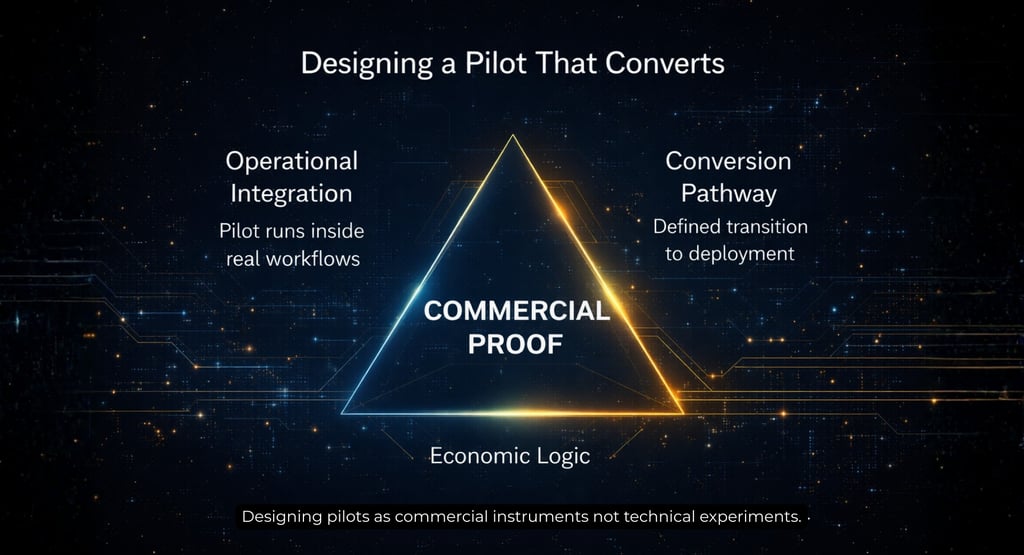
Because the pilots were designed inside real production workflows, the outcomes generated commercial credibility, not just validation. That credibility helped Redwood secure billions in capital commitments and long-term supply agreements, positioning it as critical infrastructure in the emerging EV supply chain. The lesson holds across sectors: a pilot becomes commercially meaningful when it is tied to how customers actually operate, not just how the technology performs. In next month’s issue of The Commercial Edge™, we’ll go deeper on exactly how to design pilots that convert including the three structural elements that separate experiments from early commercial instruments.
Before revenue, sophisticated buyers and investors look for:
Defined transition paths from pilot to deployment
Economic logic attached to early engagements
Evidence of repeatability across customers
Clear ownership of budget and procurement
According to BCG’s 2023 report, “An Investor’s Guide to Deep Tech,” deep tech now commands a stable 20 percent share of all venture capital funding double its share of a decade ago. But that capital increasingly flows toward teams that demonstrate credible paths from experimentation to value capture, not just technical novelty. The average deep tech investment has grown significantly, with many rounds now exceeding $100 million. The bar for what counts as commercial proof is rising with it.
The Takeaway
Pilots don’t fail because technology falls short. They fail because commercial intent is never engineered into them.
Founders who design pilots as commercial instruments, not scientific experiments, dramatically increase their odds of scaling and earning investor trust.
At Agrotera Group, we help founders design pilots that function as commercial instruments from day one. If you’re navigating the gap between proof of concept and proof of market, let’s talk.
Empowering deep tech startup founders with strategic commercialization advice.
Partners
Growth
partner@agroteragroup.com
+15127301855
© 2025. All rights reserved.
Agrotera Group