
The Missing Proof Investors Are Looking For
Deep-tech investors aren't just evaluating technology. They're looking for evidence that customers will adopt it, partners will support it, and markets are ready for it. Here's why commercial credibility has become one of the most important signals in fundraising.
6/30/20265 min read
Why Deep Tech Startups Don't Run Out of Technology. They Run Out of Commercial Credibility.
Spend enough time around deep-tech founders and you begin to notice a pattern. The companies that struggle rarely do so because the technology stops improving. In many cases, the opposite is true. The engineering team continues to hit milestones. Performance improves. New intellectual property is developed. Technical risk steadily declines. From inside the company, progress feels tangible.
Yet customer decisions take longer. Strategic partnerships remain exploratory. Investors begin asking increasingly detailed questions about commercialization rather than technology. Nothing appears broken. Still, momentum begins to slow. One of the reasons is that technical progress and commercial confidence do not always advance at the same pace. The same questions begin surfacing repeatedly:
Who will buy this first?
How will it be deployed?
Why will customers change the way they operate?
What happens after the pilot?
Those questions rarely become visible overnight. They accumulate quietly while the company continues celebrating technical achievements. And the result is often a business that becomes increasingly sophisticated from an engineering perspective without becoming significantly easier to adopt.
Nothing appears broken, technology prototyping is still solid. Still, momentum begins to slow because of adoption barriers. One of the reasons is that technical progress and commercial confidence do not always advance at the same pace. Many founders assume this is simply part of building a deep-tech company. In reality, it is often a signal that technical progress and commercial progress are no longer advancing together in tandem.
The Progress Trap
Engineering is designed to reduce uncertainty. Every prototype, simulation, test, and validation exercise answers another technical question. Over time, founders can point to a growing body of evidence that demonstrates the technology works.
Commercialization is different. The questions become less about performance and more about adoption:
Who owns the budget?
How long does procurement actually take?
Will a successful pilot lead to deployment?
Does the pricing model support long-term adoption?
Can this partnership expand beyond a single customer?
These questions often remain unanswered while the technology continues to improve. The company looks like it is reducing risk but only one category of risk is actually shrinking: the technical risk. But what about the commercial risk?
Why Investors Keep Coming Back to Commercialization
Many founders leave investor meetings feeling frustrated. The technology is stronger than it was six months ago, yet investors continue asking about customers, partnerships, pricing, procurement, and deployment. Many expect investors to focus primarily on technical differentiation. Instead, conversations keep shifting toward commercialization. This dynamic often surprises founders during fundraising.
The instinct is to believe investors are overlooking the innovation. More often, they are also evaluating something different. According to Accenture's 2023 Technology Vision, organizations are becoming increasingly capable of developing and accessing advanced technologies. The challenge is no longer technological capability alone; it is translating that capability into sustained business value. And investors recognize the same distinction.
A breakthrough technology may create opportunity, but investors are ultimately assessing whether the company has established a credible pathway to market adoption. That means understanding far more than product performance.
They are evaluating whether the founders understand customers, procurement, partnerships, deployment, pricing, and commercial execution. Technical credibility opens the door. While commercial credibility determines how far the conversation progresses.
Researchers at Wharton School's Mack Institute for Innovation Management, in a 2024 study on deep-tech commercialization, argue that deep-tech ventures face not only technical uncertainty, but equally significant commercial uncertainty as they move toward scale. The University of Pennsylvania’s research concludes that commercialization strategy and access to complementary capabilities become just as important as the underlying technology once a company begins transitioning from innovation to market adoption.
That observation mirrors what many founders experience. Technical progress answers engineering questions. However, investors are also trying to understand whether commercial uncertainty is shrinking as well.
Technical Validation Doesn't Create Commercial Confidence
Commercial confidence isn't built by proving a technology works. It is built by demonstrating that people know how to adopt it. This distinction becomes even clearer when you look at similar examples across medical, aviation and manufacturing industries.
In the medical industry, HeartFlow developed sophisticated computational models capable of diagnosing coronary artery disease without invasive procedures. Clinical performance was only part of the challenge. The company also invested heavily in reimbursement, regulatory validation, and health economics because hospitals could not adopt the technology at scale without a viable commercial pathway. Investors weren't simply evaluating a diagnostic platform. They were evaluating whether healthcare systems had a practical way to implement it.
Zipline followed a similar pattern. The company earned global recognition for autonomous drone logistics, but its credibility came from proving reliable medical deliveries in Rwanda before expanding elsewhere. Each successful deployment reduced uncertainty for governments, healthcare providers, and future partners. The technology demonstrated capability. The operating model demonstrated adoption.
And in advanced manufacturing, Carbon approached commercialization differently again. Rather than attempting to transform manufacturing broadly, it partnered with Adidas to solve a specific production challenge. That focused commercial entry point gave the company something more valuable than publicity. It provided evidence that advanced manufacturing could operate within existing production environments.
Although these companies operate in entirely different sectors, they share a common characteristic. They built evidence that adoption was achievable alongside technology worked. They built confidence with commercial evidence.
Commercial Evidence Changes the Conversation
Researchers at Stanford University, studying more than five decades of technology commercialization, found that scientific excellence alone was not a reliable predictor of commercial success. The technologies that ultimately created lasting impact were shaped by how effectively they were transferred, positioned, and commercialized.
That distinction matters because founders often assume technical validation naturally creates market confidence. It doesn't. Commercial confidence comes from evidence:
Evidence that customers will adopt.
Evidence that procurement can be navigated.
Evidence that pricing supports scale.
Evidence that partnerships create access rather than dependency.
Each piece of evidence reduces uncertainty for everyone involved including customers, strategic partners, and investors alike.
The Commercial Credibility Gap™
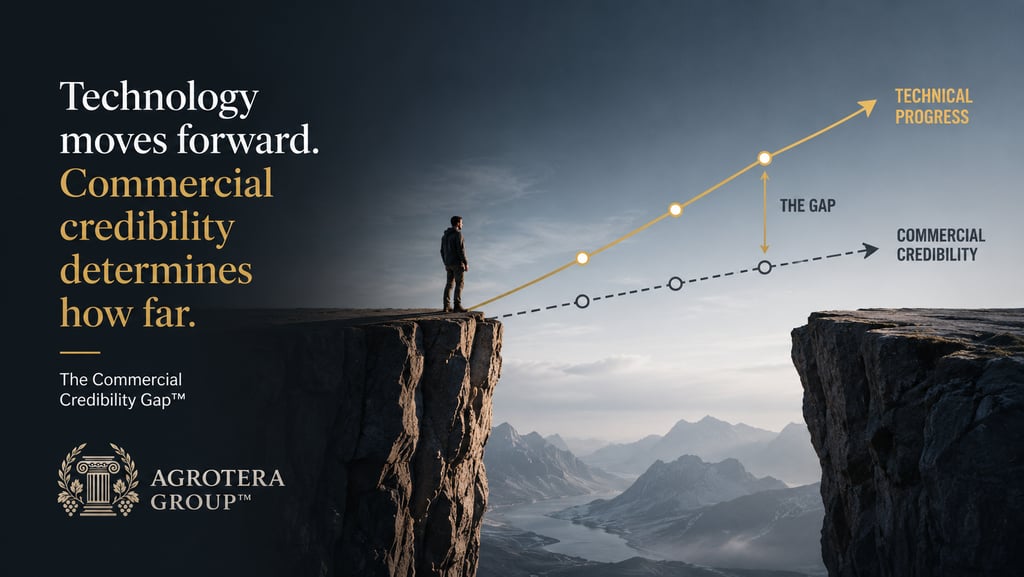
This is the pattern Agrotera has seen repeatedly across deep-tech companies. A business can become technically credible, scientifically credible, and academically credible while commercial confidence advances much more slowly. We refer to this as the Commercial Credibility Gap™.
This gap isn't created by weak technology. It forms when technical milestones outpace commercial evidence. Left unchecked, founders begin measuring success by engineering progress while customers and investors continue measuring something entirely different.
A startup can become technically credible, scientifically credible, and academically credible while still lacking the commercial evidence required for customers, partners, and investors to move forward with confidence.
The gap widens whenever technical milestones outpace commercial validation. A successful pilot may prove performance without proving scalability. A partnership announcement may generate visibility without demonstrating repeatable market access. A prototype may validate engineering assumptions while leaving pricing, procurement, and deployment unanswered. From inside the company, everything appears to be progressing. But from outside the company, uncertainty remains. That difference in perception matters.
An Agrotera Perspective
Commercialization should be subjected to the same discipline as engineering. Founders prototype technology because they know assumptions should be tested before production. Commercial assumptions deserve the same treatment.
The strongest companies don't wait for the market to reveal weaknesses in their commercialization strategy. They deliberately test adoption assumptions, partnership structures, pricing models, and deployment pathways while the cost of changing course is still relatively low.
That is the foundation of what Agrotera calls Commercial De-Risking™. Not reducing ambition but reducing avoidable commercial uncertainty.
One of the central principles behind Commercial De-Risking™ is that commercialization should be subjected to the same discipline founders apply to engineering with commercial prototyping™ done in tandem with R&D prototyping. Both must occur simultaneously together with neither the commercial not the technical aspect outpacing the other.
Closing Thoughts: Technical progress creates the market opportunity while commercial credibility creates confidence required for adoption and scale. As deep-tech funding becomes more selective, investors are looking beyond engineering milestones to evaluate commercial credibility, market adoption, and long-term scalability. The companies that consistently secure investment, attract strong partners, and scale successfully understand that both forms of progress matter. They don't assume commercial confidence will emerge once the technology is ready. They build it deliberately along with the technology, one piece of evidence at a time.
These companies build evidence that demonstrates how their technology fits into existing markets, solves meaningful problems, and can be adopted at scale. This type of evidence becomes commercial credibility. And in deep tech, commercial credibility is often the resource that determines whether technical success becomes commercial success.
If you're working through where commercial risk may be accumulating in your business, let's have a conversation.
©Agrotera Group™. All rights reserved.

